
Delayed shipments, rising fuel costs, warehouse inefficiencies, and growing customer demand for same-day delivery are putting massive pressure on logistics companies. Add ongoing supply chain disruptions and unpredictable demand, and traditional logistics systems start falling behind. Reactive planning and manual operations are no longer enough for modern supply chains.
This is where AI for logistics is changing the industry. Companies are shifting toward predictive, AI-powered systems that optimize routes, automate warehouses, improve inventory management, and identify disruptions before they impact operations.
According to McKinsey, embedding AI into operations can reduce inventory levels by 20–30%, lower logistics costs by 5–20%, and decrease procurement spend by 5–15%. Gartner research also shows supply chain leaders are actively scaling AI across logistics workflows, while IBM highlights AI’s growing role in route optimization and real-time visibility.
While many discussions around AI in logistics focus on automation, the real impact goes far beyond that. This guide explores practical AI use cases, ROI, implementation strategies, future trends, and how logistics companies are building smarter, more resilient supply chains.
AI for logistics refers to the use of artificial intelligence technologies to improve how goods are stored, transported, tracked, and delivered across the supply chain. In simple terms, it helps logistics companies make faster, smarter, and more accurate operational decisions using data and automation.
AI for logistics combines machine learning, predictive analytics, automation, and real-time data processing to improve transportation management, warehousing, fleet operations, inventory control, and overall supply chain decision-making. Instead of relying only on manual planning and historical reports, AI systems can analyze live operational data and recommend the best actions instantly.
AI-powered logistics systems use several technologies together to improve efficiency and visibility across operations.
Machine learning helps systems learn from historical data and improve decision-making over time. For example, AI can predict delivery delays, forecast demand spikes, or optimize inventory based on past trends and real-time conditions.
Computer vision is commonly used in warehouses for barcode scanning, package identification, inventory tracking, and quality checks. It helps reduce manual errors and speeds up warehouse operations.
Predictive analytics allows logistics companies to forecast disruptions, estimate delivery times, identify maintenance risks, and improve route planning before issues occur.
IoT integration connects vehicles, warehouse equipment, sensors, and tracking devices to AI systems. This creates real-time visibility across shipments, fleets, and inventory movement.
Generative AI is now helping logistics teams automate reports, shipment summaries, customer communication, invoice processing, and operational documentation using natural language tools.
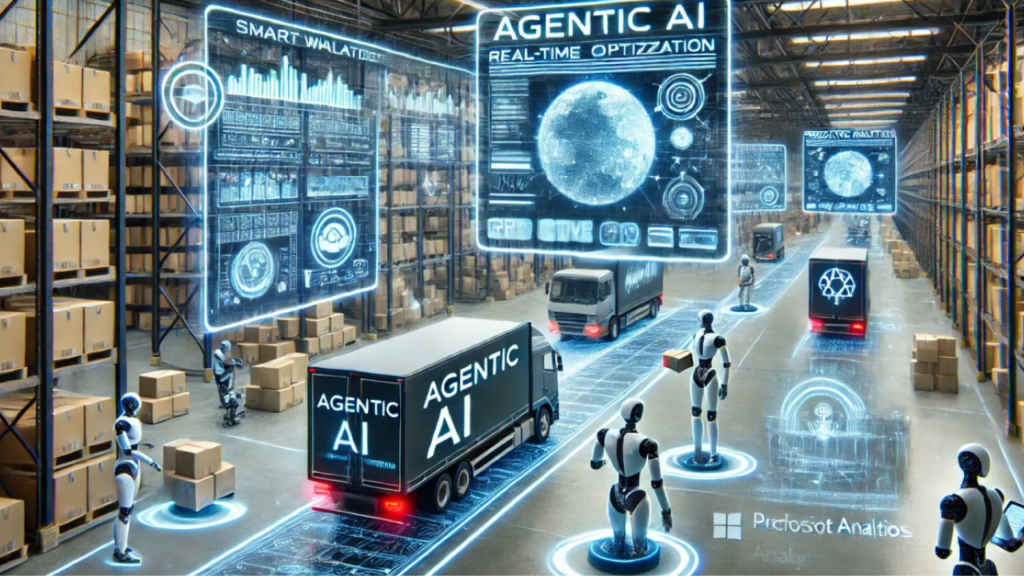
Agentic AI systems take automation a step further by enabling AI agents to make decisions autonomously. These systems can monitor supply chain conditions, reroute shipments, manage workflows, and coordinate logistics tasks with minimal human intervention.
Traditional logistics operations depended heavily on manual planning, spreadsheets, disconnected systems, and reactive decision-making. Teams often responded to delays or disruptions only after they happened, which slowed operations and increased costs.
Modern AI-powered logistics systems work very differently. They use predictive forecasting, autonomous workflows, intelligent route planning, and real-time supply chain visibility to improve efficiency proactively. Instead of waiting for problems to happen, AI helps companies anticipate disruptions, optimize resources, and make continuous operational improvements.
As logistics networks become more complex, AI is becoming a critical technology for improving speed, accuracy, and supply chain resilience.
The logistics industry is becoming more complex, fast-moving, and data-driven. Rising costs, supply chain disruptions, growing customer expectations, and massive operational data are pushing companies to rethink traditional logistics systems. Manual planning and reactive operations are no longer enough, which is why businesses are rapidly adopting AI for logistics.
Logistics companies are dealing with multiple operational challenges at the same time, including:
These challenges directly impact profitability and operational efficiency. AI helps reduce these pressures by optimizing delivery routes, automating repetitive warehouse tasks, improving fleet utilization, and identifying bottlenecks before they create delays. Instead of relying on manual scheduling and planning, AI-powered logistics systems make faster and more accurate operational decisions in real time.
Modern supply chains are more vulnerable to disruptions than ever before. Common challenges include:
Even a small disruption can affect multiple parts of the logistics network. AI allows companies to shift from reactive problem-solving to proactive risk management. Predictive AI models can forecast disruptions early, recommend alternative routes, identify inventory shortages, and improve supply chain resilience before problems escalate. Gartner notes that AI-powered orchestration is helping organizations improve disruption response and gain better end-to-end visibility across supply chains.
Customer expectations are rapidly changing, especially in eCommerce and retail logistics. Today’s customers expect:
Meeting these expectations manually is extremely difficult at scale. AI helps logistics companies analyze live operational conditions, predict delays, optimize fulfillment operations, and improve delivery accuracy. This creates faster, more reliable, and more transparent customer experiences.
Modern logistics operations generate enormous amounts of data every day from multiple systems, including:
The challenge is not collecting data; it is processing and using it effectively. Human teams cannot manually analyze millions of data points fast enough to make real-time operational decisions. AI helps logistics companies process this information instantly, identify patterns, predict operational risks, and automate workflows with far greater speed and accuracy than traditional systems.
As logistics operations continue to become more connected and data-driven, AI is becoming essential for companies that want lower operational costs, greater efficiency, and stronger supply chain visibility.
AI is no longer limited to basic automation in logistics. Today, logistics companies are using AI to improve route planning, warehouse operations, inventory forecasting, fleet management, and end-to-end supply chain visibility. From reducing fuel costs to predicting disruptions before they happen, AI is transforming how logistics operations function at scale.
Route optimization is one of the most widely adopted use cases of AI for logistics. Traditional route planning systems often rely on static maps and manual scheduling, which makes it difficult to respond to changing road conditions in real time. AI-powered route optimization systems continuously analyze live operational data to identify the fastest, safest, and most cost-efficient delivery routes.
AI systems can process:
Instead of using fixed delivery routes, AI adjusts routes instantly based on changing conditions. This helps logistics companies reduce delays, improve delivery efficiency, and lower operational costs.
Key benefits include:
According to Gartner, 75% of large logistics enterprises are expected to adopt AI for route optimization as companies continue focusing on efficiency and sustainability.
Forecasting demand accurately is critical for logistics and supply chain management. Poor forecasting can lead to overstocking, inventory shortages, delayed deliveries, and increased storage costs.
AI-powered predictive forecasting helps logistics companies make smarter inventory and supply chain decisions by analyzing large volumes of operational and market data. Instead of relying only on historical sales reports, AI can identify patterns and predict future demand more accurately.
AI forecasting models analyze:
It allows businesses to:
A Gartner study cited by Forbes found that AI-driven predictive analytics can reduce forecasting errors by up to 50%, helping logistics companies operate more efficiently while improving customer fulfillment rates.
Warehouses are becoming smarter, faster, and more automated with AI-powered technologies. Traditional warehouse operations often depend on manual inventory tracking, repetitive picking tasks, and disconnected systems that slow down productivity.
AI warehouse automation improves efficiency through:
AI-powered robots can move inventory, sort packages, and assist warehouse staff with repetitive tasks much faster than traditional systems. Computer vision technology also helps warehouses improve barcode scanning, product identification, and quality control.
However, the future of warehouse automation goes beyond robotics alone. Many businesses are now adopting:
Digital twins allow logistics companies to create virtual warehouse environments where they can test operational changes before applying them in real facilities. AI simulations help optimize warehouse layouts, workforce allocation, and inventory movement for maximum efficiency.
Gartner predicts that by 2030, nearly half of new warehouses could become robot-centric as businesses continue investing in automation technologies.
Last-mile delivery is often the most expensive and operationally complex part of logistics. Delays, failed deliveries, traffic congestion, and changing customer expectations make last-mile operations difficult to manage efficiently.
AI helps logistics companies improve last-mile delivery through:
AI systems can predict traffic conditions, optimize driver schedules, and update delivery routes in real time to improve delivery accuracy. Customers also receive more accurate ETAs and real-time shipment updates, improving the overall delivery experience.
Major logistics and e-commerce companies such as Amazon, DHL, and UPS are actively investing in AI-driven delivery optimization technologies to improve speed, visibility, and customer satisfaction.
Managing large vehicle fleets manually can be expensive and inefficient. AI-powered fleet management systems help logistics companies monitor vehicle performance, improve driver safety, reduce fuel consumption, and optimize overall fleet operations.
AI fleet management solutions support:
One of the biggest advantages of AI fleet management is predictive maintenance. AI systems can analyze engine performance, sensor data, and historical maintenance records to identify potential vehicle issues before breakdowns occur.
It helps businesses:
AI also helps optimize fleet usage by identifying underutilized vehicles, improving delivery schedules, and reducing unnecessary fuel consumption.
Modern supply chains involve multiple suppliers, warehouses, transportation networks, and distribution centers operating simultaneously. Without real-time visibility, even small disruptions can create major delays across the supply chain.
AI-powered supply chain visibility systems help companies monitor operations continuously through:
AI systems analyze operational data from across the logistics network to identify potential risks early. Instead of reacting to disruptions after they happen, businesses can proactively adjust inventory, reroute shipments, or change suppliers before operations are affected.
It is an important area that many discussions around AI in logistics overlook. AI is not only improving efficiency, but it is also helping companies build stronger supply chain resilience.
According to insights from Forbes and Gartner, AI-powered supply chain orchestration improves disruption response, operational visibility, and long-term resilience across logistics networks.
One of the fastest-growing areas of AI for logistics is generative AI and agentic AI systems. While many businesses already use AI for automation and analytics, newer AI models are now capable of handling complex operational workflows with minimal human intervention.
Generative AI helps logistics companies automate tasks such as:
AI copilots can also assist operations teams by answering logistics questions in natural language, generating insights from operational data, and helping teams make faster decisions.
Agentic AI systems take automation even further by allowing AI agents to act independently across logistics workflows. These systems can:
In the future, generative AI and agentic AI could become the foundation of autonomous logistics operations, where AI continuously manages supply chain processes, predicts disruptions, and optimizes workflows with minimal human involvement.
AI is helping logistics companies reduce costs, improve delivery performance, and gain better supply chain visibility through smarter, data-driven operations. As supply chains become more complicated, businesses are increasingly using AI to improve efficiency, resilience, and scalability.
One of the biggest advantages of AI for logistics is cost reduction. Logistics companies often deal with rising transportation costs, fuel expenses, labor shortages, and warehouse inefficiencies that directly impact profitability.
AI helps reduce these costs by:
Instead of relying on manual planning, AI-powered systems analyze real-time operational data to identify the most efficient ways to move goods across the supply chain.
Logistics operations generate massive amounts of real-time data every day. Shipment tracking, warehouse activity, GPS systems, inventory movement, and fleet telematics constantly produce operational information that businesses need to analyze quickly.
AI helps companies process this data instantly and make faster operational decisions. Instead of waiting for manual analysis or reports, AI systems can:
This allows logistics companies to respond to changing conditions much faster and improve overall operational agility.
Customer expectations in logistics continue to rise, especially in e-commerce and retail delivery. Customers now expect faster deliveries, accurate shipment updates, and transparent communication throughout the delivery process.
AI helps improve customer experience by supporting:
AI-powered logistics systems continuously monitor delivery conditions and provide customers with live updates, helping businesses create more reliable and predictable delivery experiences.
Supply chain disruptions have become so common due to weather events, geopolitical instability, changing demand patterns, and transportation delays. Traditional logistics systems often react to problems only after disruptions occur.
AI helps logistics companies become more proactive by identifying risks before they escalate. Predictive AI models can monitor supply chain conditions in real time, forecast potential disruptions, and recommend alternative actions to minimize operational impact.
This improves:
Instead of simply reacting to disruptions, businesses can use AI to strengthen supply chain resilience and maintain more stable operations during uncertainty.
Warehouses are becoming more efficient with AI-powered automation and intelligent operational systems. Manual inventory management and repetitive warehouse tasks often slow down fulfillment operations and increase the risk of errors.
AI improves warehouse efficiency through:
AI-powered systems can monitor warehouse activity in real time, improve picking accuracy, optimize storage layouts, and help businesses allocate labor more efficiently during high-demand periods.
Here are the following challenges of implementing AI in logistics:
AI systems depend on data to make accurate decisions. If logistics data is incomplete, outdated, inconsistent, or disconnected across systems, AI performance can suffer significantly.
Common data challenges include:
Many logistics companies collect large amounts of operational data but struggle to organize and standardize it properly. Gartner emphasizes that weak data readiness is one of the biggest factors slowing AI adoption across supply chains.
Without clean and reliable data, even advanced AI systems may produce inaccurate forecasts, routing decisions, or operational recommendations.
Many logistics companies still rely on older software systems that were not designed to support AI-powered operations. These disconnected platforms often create data silos that limit real-time visibility and operational efficiency.
Common legacy system challenges include:
Integrating AI into these environments can be difficult and time-consuming. Businesses often need to modernize parts of their infrastructure before AI systems can work effectively across the supply chain.
Implementing AI in logistics requires significant upfront investment, especially for large-scale operations. While AI can reduce long-term operational costs, the initial setup process can be expensive for some businesses.
Key investment areas include:
In addition to technology costs, companies must also invest time and resources into testing, deployment, and operational adjustments. This is why many organizations start with smaller pilot projects before scaling AI across larger logistics operations.
AI is changing how logistics teams work. While AI automates repetitive tasks and improves operational efficiency, human expertise still plays a critical role in managing supply chain strategy, decision-making, and oversight.
This shift creates new workforce challenges, including:
Many employees worry that AI will replace jobs entirely. In reality, most logistics companies are using AI to support human teams rather than eliminate them. Gartner notes that leading organizations are redesigning roles so employees can focus more on judgment, strategy, and exception management while AI handles repetitive operational decisions.
As AI adoption grows, workforce training and human-AI collaboration will become increasingly important for successful implementation.
AI-powered logistics systems depend on connected data across vehicles, warehouses, suppliers, and transportation networks. It creates additional cybersecurity and data privacy concerns that businesses must manage carefully.
Potential risks include:
Because logistics operations rely heavily on real-time connected systems, even small security issues can disrupt operations significantly. Companies implementing AI must invest in strong cybersecurity practices, secure cloud infrastructure, and data protection policies to reduce operational risks.
As logistics networks become more connected and AI-driven, balancing innovation with security will remain a major priority for the industry.
Start with logistics areas where AI can create immediate operational value. Instead of trying to automate everything at once, focus on high-impact use cases such as:
It helps businesses achieve faster ROI and smoother implementation.
AI systems rely on accurate and connected data to perform effectively. Before implementation, companies should strengthen their data infrastructure through:
Better data quality improves AI accuracy and operational visibility.
Many successful logistics companies begin with smaller AI pilot programs before scaling across the entire organization. A phased adoption approach helps businesses:
Once results are proven, companies can expand AI adoption more confidently.
AI works best when combined with human expertise. Logistics teams should understand how to use AI systems effectively and work alongside automation tools.
Key focus areas include:
Training helps employees adapt to new workflows while improving adoption across teams.
Tracking performance is essential for long-term AI success. Logistics companies should monitor key KPIs to measure operational impact and identify areas for improvement.
Important metrics include:
Continuous performance monitoring helps businesses optimize AI systems and maximize long-term ROI.
AI-powered delivery technologies are expected to transform last-mile logistics in the coming years. Companies are actively exploring drones, self-driving vehicles, and robotic delivery systems to improve delivery speed, reduce costs, and increase operational efficiency.
AI digital twins create real-time virtual simulations of warehouses and supply chain operations. These systems help logistics companies test workflows, predict bottlenecks, and optimize operations before making real-world changes.
Agentic AI systems can monitor supply chains, coordinate workflows, and respond to disruptions automatically. These intelligent systems help businesses improve operational efficiency through faster and more autonomous decision-making.
AI is helping logistics companies deliver more personalized customer experiences through customized delivery schedules, smarter inventory planning, and predictive fulfillment strategies. It improves both customer satisfaction and delivery efficiency.
Future smart warehouses will combine robotics, IoT devices, predictive systems, and automated inventory management. These connected systems improve warehouse speed, accuracy, visibility, and overall operational productivity.
AI for logistics is transforming the entire supply chain, from route optimization and warehouse automation to forecasting and customer experience. The impact goes far beyond automation, helping businesses improve resilience, operational efficiency, and real-time decision-making.
Companies delaying AI adoption risk higher costs, slower deliveries, and weaker supply chain visibility. The logistics companies winning in the next decade will not simply move goods faster; they will make smarter AI-driven decisions at every stage of the supply chain.
AI for logistics is used to improve route optimization, demand forecasting, warehouse automation, inventory management, and fleet operations. AI systems analyze real-time logistics data to reduce delays, optimize delivery routes, improve warehouse efficiency, and support faster operational decision-making.
AI helps logistics companies reduce operational costs, improve delivery speed, increase supply chain visibility, and optimize overall efficiency. It also supports better forecasting, lower fuel consumption, improved customer experiences, and smarter inventory management.
Yes, AI can significantly improve supply chain management through predictive analytics, automation, and real-time visibility. AI helps businesses forecast demand, identify disruptions early, optimize inventory planning, and improve operational resilience across the supply chain.
AI-powered route optimization uses real-time traffic data, weather conditions, delivery priorities, and GPS tracking to identify the fastest and most efficient delivery routes. This helps logistics companies reduce fuel costs, improve delivery times, and increase fleet productivity.
Some of the biggest challenges include poor data quality, legacy system integration, high implementation costs, and employee training requirements. Many businesses also need to improve data infrastructure and cybersecurity before scaling AI across logistics operations.
Let’s make it Happen!
Book a free intro call. Tell us about your idea and when you want to launch—we’ll map out how to make it real.
A few quick details and we’ll reach out.
From strategy to implementation, Genboot helps enterprises secure identities, simplify access, and govern users, applications, and AI agents.
Let’s make it Happen!