
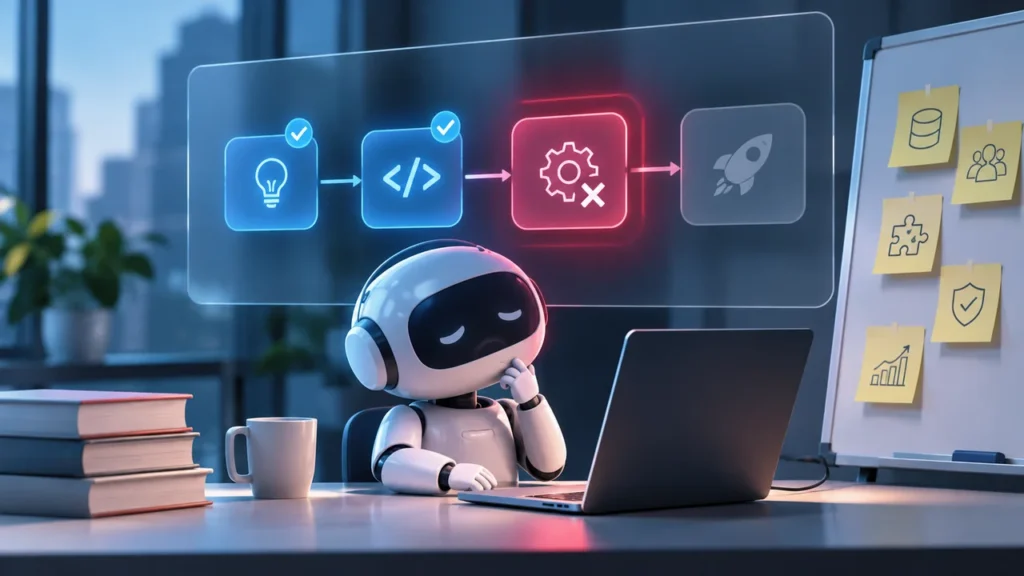
Imagine creating an AI agent to solve your biggest business problem, only to find nothing has been resolved.
A Fortune 500 supply chain team spent eight months building an AI agent to automate vendor negotiations. The demo was flawless. The board loved it. Eleven weeks after launch, the project was quietly shelved, not because the model was weak, but because nobody had mapped what the agent should do when a vendor’s ERP data didn’t match the contract terms it was reading.
That story isn’t unusual. It’s the norm.
Gartner predicts that by the end of 2027, over 40% of agentic AI projects will be discontinued, citing escalating costs, unclear business value, and inadequate risk controls as the primary drivers. That’s not a technology problem. It’s a planning problem, and it’s showing up in company after company that treated agent deployment like a demo instead of a system.
This is why businesses are increasingly turning to experienced AI agent development service providers to build production-ready AI agents with the right data, governance, and deployment strategy from day one.
Enterprise interest in AI agents has outpaced enterprise readiness to run them. And the number says it all. McKinsey’s 2025 State of AI survey found that 23% of organizations are already leveraging an agentic AI system in at least one of their business function, with another 39% experimenting. That sounds like momentum. But the same report found that only 39% of organizations report any enterprise-level EBIT impact from AI, and just 6% qualify as genuine high performers.
The gap between “we built an agent” and “the agent is producing measurable business value” is where most projects quietly die. MIT’s Project NANDA went further, finding that 95% of organizations deploying generative AI saw zero measurable return on their investment as of mid-2025. The technology worked. The business case didn’t survive contact with production.
Did you know that many vendors rebrand the chatbots and RPA tools and market them as agentic AI, called agent washing? As per Gartner, only around 130 offer genuine autonomous AI capabilities. Various businesses fall into this trap. Vendors build a rule-based and scripted workflow with an LLM bolted on it and call it an agent. And there’s no surprise when it can’t adapt to changes and fails to handle exceptions like a true AI agent.
A real agent needs to plan, use tools, retain context across steps, and recover from failure without a human rewriting its instructions every time an edge case appears. Most POCs never test for that. They test the happy path, sip it, and watch it break the first week it meets messy real-world data.
Gartner projects that 60% of AI projects lacking AI-ready data will be abandoned through 2026, and that failure rate is already visible in roughly 42% of U.S. companies today (Gartner, cited in SR Analytics, 2025). Agents are only as reliable as the systems they query. If customer records live in three disconnected tools with inconsistent fields, an agent won’t figure it out, it will make decisions on bad data and erode trust the first time it’s wrong in front of a customer.
No one takes accountability for what will happen after deploying the AI agents. Internal teams design, ship it and move to the next project. But nobody owns the monitoring, retraining, or escalation paths. The results? Either AI agents are disabled or are causing harm that no one is watching. Even Gartner stated that 40% of enterprises will demote their AI agents due to governance issues.
McKinsey’s data shows that even among companies “using” agents, no more than 10% are scaling them within any single business function. Most stay confined to one narrow use case. High performers are nearly three times more likely to have redesigned the underlying workflow, not just layered AI on top of it (McKinsey & Company, 2025). A pilot built to impress a steering committee and a system built to run in production are different engineering problems. Teams that don’t distinguish between the two build something that can’t survive contact with real transaction volume.
The organizations getting real ROI from AI agents share a pattern:
Gartner’s research backs this up directly: 45% of high-maturity organizations keep AI projects operational for three or more years, compared to just 20% of low-maturity ones.
This is also where the build-versus-partner decision matters. Internal teams without prior agent deployment experience tend to repeat the same mistakes: underestimating data prep, skipping failure-mode testing, and shipping without a monitoring plan.
Experienced AI agents development services providers have already made those mistakes on someone else’s dime and built the guardrails to avoid repeating them:
The gap between an AI agent that impresses a room and one that survives a quarter in production isn’t about which model you use. It’s about whether anyone stress-tested the data, the failure modes, and the ownership plan before go-live. Companies that treat agent deployment as a systems engineering problem, “not a demo,” are the ones showing up in that small, profitable minority. Everyone else is funding Gartner’s next cancellation statistic.
Why do most AI agent projects fail before reaching production?
Most AI agent projects fail due to poor data readiness, unclear success metrics, and a lack of ownership after launch, not because the underlying AI model is inadequate. Gartner attributes agentic AI project cancellations primarily to escalating costs, unclear business value, and inadequate risk controls. Working with experienced AI agents development services providers can help businesses address these issues before deployment.
What percentage of AI agent projects actually get canceled?
Gartner predicts more than 40% of agentic AI projects will be canceled by the end of 2027. It also projects that 30% of generative AI projects are abandoned after the proof-of-concept stage. These figures highlight why organizations increasingly rely on AI agent development services to build scalable, production-ready solutions.
How is an AI agent different from a chatbot or automation script?
A genuine AI agent plans multi-step actions, uses external tools, retains context, and adapts when it encounters exceptions. Gartner estimates that only about 130 vendors globally offer this kind of true agentic capability. Most so-called “agentic” tools are simply rebranded chatbots or RPA scripts. Experienced AI agents development services teams can help organizations distinguish between true AI agents and basic automation.
How can a company avoid becoming another AI agent failure statistic?
Start with one workflow tied to a measurable business outcome. Audit and improve the underlying data before building agent logic, and design monitoring and human escalation paths into the system from day one. Many organizations partner with AI agent development services providers to reduce implementation risks, validate real-world performance, and avoid common deployment failures.
Let’s make it Happen!
Book a free intro call. Tell us about your idea and when you want to launch—we’ll map out how to make it real.
A few quick details and we’ll reach out.
From strategy to implementation, Genboot helps enterprises secure identities, simplify access, and govern users, applications, and AI agents.
Let’s make it Happen!